



24 Jun 2025


Agile software development is fundamentally about improving the flow of work; delivering value to users quickly, safely, and predictably.
It may not seem obvious, but agile teams have much in common with smart motorways: systems designed to manage congestion, prevent bottlenecks, and optimise throughput using responsive real-time controls. Smart motorways arguably get a negative press and can rightly be criticised for perceived safety issues or confusion over lane rules, but the reality and the science is that they drastically increase flow and reduce congestion when managed correctly. The same can be said of Agile: when misunderstood or poorly implemented it can frustrate teams, but when applied with discipline and insight, it can transform delivery.
With a traditional motorway traffic can grind to a halt as cars funnel into narrower lanes, follow each other too closely or brake suddenly and unnecessarily. Similarly in software delivery teams start to slow down when too much work is in progress at once or when handovers between people and teams are inefficient. Agile frameworks help teams smooth this flow by limiting work in progress, improving feedback loops, and maintaining a sustainable pace, in a similar way to how smart motorways use variable speed limits and dynamic lane controls to keep vehicles moving.
One of the core features of a smart motorway is variable speed control. Slowing drivers down to keep things flowing might seem counterintuitive but it works by reducing sudden braking and erratic lane changes, both of which lead to traffic congestion. Agile teams can apply the same principle by deliberately reducing the number of active tasks. Slowing the pace at which work enters the system reduces context switching and improves focus, resulting in faster and higher quality outcomes. Paradoxically, slowing down helps teams go faster overall.
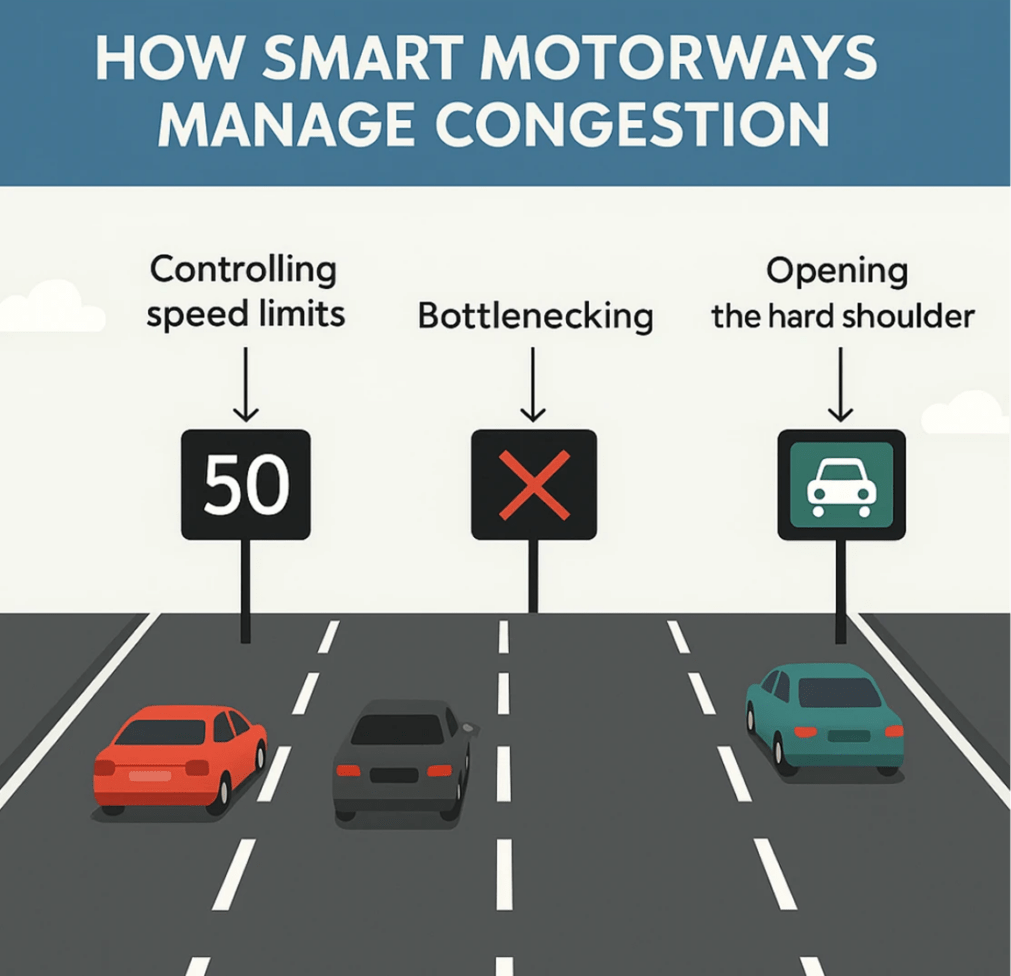
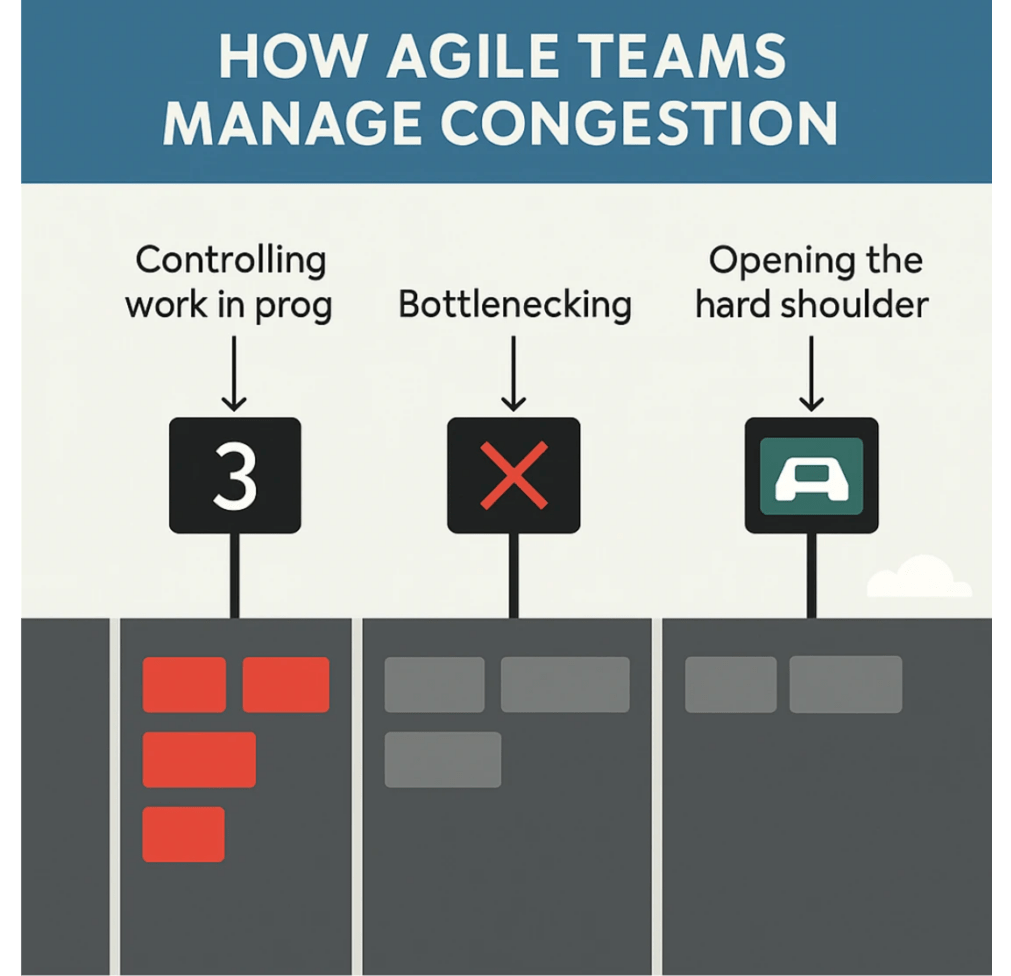
Another smart motorway feature is management of bottlenecks. When a junction becomes overwhelmed or an incident blocks a lane, the system reacts by adjusting speeds or rerouting vehicles. In Agile, bottlenecks often appear at predictable places: code reviews, testing, or deployments. Agile teams can manage these by increasing automation, cross-skilling team members, or rebalancing workloads. This ensures that no one area becomes a persistent drag on throughput.
Perhaps the most controversial element of smart motorways is how they manage the hard shoulder. This is the lane typically reserved for emergencies, but it can be opened to traffic in peak conditions to add extra capacity. In software terms this is akin to bringing in additional team members temporarily, repurposing specialist roles, or asking other teams to help absorb demand. But just like smart motorways this move comes with a cost. Just as using the hard shoulder requires extra monitoring and signage to ensure safety, pulling in extra resources requires increased coordination, onboarding, and context sharing. It is a tactic best used sparingly and only when the flow really demands it.
Ultimately, both smart motorways and agile software development aim to make complex systems work smoothly under variable and often unpredictable conditions. They do this not through brute force, but through systems thinking: understanding how individual actions impact overall flow, and responding dynamically to change.
So, next time your team hits congestion, ask: are we managing our flow like a smart motorway or are we just piling more cars onto a jammed road? Sometimes the best way forward is not to speed up, but to flow better.
No matter where you are on your Agile journey, just getting started or looking to level up, Atomic are here to help. With the right guidance, tools, and mindset, Agile can transform the way your team collaborates, adapts, and delivers value. Together, we can turn Agile from a process into a mindset and your organisation into a truly adaptive force.
Ready to take the next step? We’re just a conversation away.